Data is a tool, an asset for making a better decisions which can be act as a supreme driver of business value. Now a days, Python is one of the fastest growing programming languages. With the help of this programming language, we can easily do the followings —
- Data manipulation with Pandas,
- Creating fabulous visualizations with Seaborn, or
- Scaling Analytics, Deep Learning and AI Data model with TensorFlow,


So, we can trust on the Python language which seems to have a tool for everything.
In the current era, the volumes of data generated continue to grow at a rapid pace across structured, semi structured, and unstructured data types that businesses are now able to store and need to analyze.
Few years back, Cloud Technology was considered an optional technology environment but now a days, it is the foundation for modernizing data management and most of the organizations use cloud services or infrastructure widely in their data architecture.

Pandas is a Python package that provides fast, flexible, and expressive data structures designed to make working with structured like tabular, multidimensional, potentially heterogeneous and time series data both easy and intuitive. It aims to be the fundamental high-level building block for doing practical, real world data analysis in Python.
OS comes under Python’s standard utility modules. This module provides a portable way of using operating system-dependent functionality. os.listdir(‘your_path’) will list all content of a directory
NumPy is a library for the Python programming language, adding support for large, multi-dimensional arrays and matrices, along with a large collection of high-level mathematical functions to operate on these arrays.
SQLite3 can be integrated with Python using sqlite3 module, which provides an SQL interface compliant with the DB-API 2.0 specification described by PEP 249. You do not need to install this module separately because it is shipped by default along with Python version 2.5.x onwards.

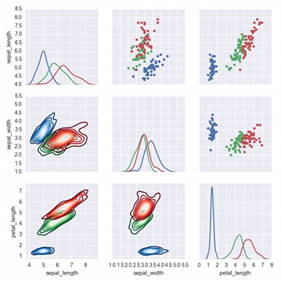
Seaborn is a Python data visualization library based on matplotlib. It will be used to visualize random distributions and provides a high-level interface for drawing attractive and informative statistical graphics.
Matplotlib is a comprehensive library for creating static, animated, and interactive visualizations in Python, and its numerical mathematics extension NumPy. It provides an object-oriented API for embedding plots into applications using general-purpose GUI toolkits like Tkinter, wxPython, Qt, or GTK.


Note:
1. Seaborn supports Python 3.7+ and no longer supports Python 2.
2. TensorFlow now supports Python 3.5.x through Python 3.8.x, but you still have to use a 64-bit version.


To learn more, please follow us -
http://www.sql-datatools.comTo Learn more, please visit our YouTube channel at —
http://www.youtube.com/c/Sql-datatoolsTo Learn more, please visit our Instagram account at -
https://www.instagram.com/asp.mukesh/To Learn more, please visit our twitter account at -
https://twitter.com/macxima


Great survey, I'm sure you're getting a great response. Peter Black
ReplyDeleteVery efficiently written information. It will be beneficial to anybody who utilizes it, including me. Keep up the good work. For sure i will check out more posts. This site seems to get a good amount of visitors. Anthony Clark
ReplyDeleteThe article highlights Python as a versatile programming language with a rich ecosystem of libraries for data analysis, visualization, artificial intelligence, cloud computing, and enterprise application development. Libraries such as Pandas, NumPy, Seaborn, Matplotlib, and TensorFlow enable developers to manipulate data, build predictive models, create insightful visualizations, and develop scalable analytical solutions. This broad ecosystem makes Python one of the most preferred languages for data science, machine learning, and modern software development.
ReplyDeletePython provides powerful tools for data analysis by simplifying data cleaning, transformation, visualization, and statistical exploration through libraries like Pandas and NumPy. These capabilities help analysts and developers extract meaningful insights from structured and unstructured datasets while supporting informed business decisions. Students and professionals interested in mastering these techniques can explore Data Analysis Training, which covers practical methods for working with real-world datasets and analytical workflows.
Python also plays a central role in machine learning by providing robust frameworks for building predictive models, intelligent automation, recommendation systems, and data-driven applications. Combining data preprocessing with AI algorithms enables developers to solve complex real-world problems across multiple industries. Those looking to strengthen their practical AI skills can further explore Machine Learning Projects for Final Year, featuring hands-on implementations of classification, prediction, clustering, and intelligent analytics.
ReplyDeleteReaders interested in expanding their Python programming knowledge can also refer to Python Training, which introduces essential Python libraries, frameworks, and concepts widely used in data science, machine learning, Artificial Intelligence, and enterprise application development.
ReplyDelete